I eat rejections for breakfast.
![Rejection letter snippet with the highlighted words: We appreciate the opportunity to read your writing, but […]"](/content/images/size/w960/2026/03/rejection-letter-snippet-boxshadowed-1.png)
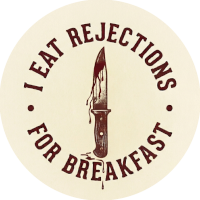
Someone make me a t-shirt. I need it to read "I eat rejections for breakfast."
If you are serious about your craft, you must learn to embrace rejection, otherwise you are teeing yourself up for a whole lot of heartache and woe. Earlier this month, I submitted a personal narrative (a short memoir focused on a particular experience) to a literary journal. Every day, I'd check my mail waiting for word from the publisher, knowing full well, it could take days, weeks, or even months before they read and considered it. Well today—March 25, 2026—was the day. An email sat in my mailbox from the literary journal.
I know what to expect most of the time, so when I clicked to open the email, I may have said something to the effect of, "Okay, you bastards. Bring it on!"
I read the email carefully, then smiled and nodded. Ha! A rejection. Nicely worded. "Keep at it, young feller!" and all that. I didn't gripe and moan. I didn't cry on my wife's shoulder. (She is tired of that anyway.) I didn't hug my dog and thank him for being "my very bestest buddy in the whole wide world." (He is.) Nope! I smiled, shrugged, printed it out, and scrawled across the top in blood red ink: "REJECTED! March 25, 2026!" I then flung it into my inbox to be filed away in the now-pregnant rejections folder. Grimly satisfied, I went back to work.
In the past, I've only really submitted to one particular regional literary journal. I have been rejected by them as well, of course. But I persisted, and they have accepted a number of my short works. In the last year, I have begun to branch out—to get my words into other journals, magazines, and anthologies. I have even submitted to some of the big names: The New Yorker, The Atlantic, Granta, Ecotone, and more. The New Yorker and The Atlantic don't reject though, per se. They simply never respond. Bah! Not satisfying. I want a rejection!
Rejection is a part of the creative process. Rejection means you are making the attempt. It means you are out there doing the work and taking risks. Every writer has been rejected, and the great majority have been rejected many many many times. The only writers who have avoided rejection are those who write in private. That has its place, of course. But there comes a time when you want to share your words. Your art. Your creative mind.
Let's hear from some accomplished writers …
Could we start reframing rejection as something necessary, even desirable—not shameful, but an important step on the artistic journey? Rejection doesn’t automatically mean falling short; it can mean that risks are being taken, that you’re innovating. At the very least, it means that you’re trying. We need to be transparent about the work, about how 99% of the time it’s a thick skin that does more for artists than bolt-from-the-blue talent. And also about the toll it can take on you.
—Sophie Mackintosh, The Guardian (2019)
Indeed, Sophie! Developing a thick skin is necessary for more than a writing career. It is a necessary trait to get you through life.
Rejection is an enormous part of a writer’s life. It’s just the way it is. There are so many people out there wanting to show and sell their work. It’s easy to get lost and very difficult to get attention.
—Sigrid Nunez, The Cut (2020)
Exactly. Your work is in competition with a great many other writers. They've had their share of rejections where someone else's work had been selected over theirs. Today, their story was selected over yours.
It does help, to be a writer, to have the sort of crazed ego that doesn’t allow for failure. The best reaction to a rejection slip is a sort of wild-eyed madness, an evil grin, and sitting yourself in front of the keyboard muttering[,] “Okay, you bastards. Try rejecting this!” and then writing something so unbelievably brilliant that all other writers will disembowel themselves with their pens upon reading it, because there’s nothing left to write. Because the rejection slips will arrive. And, if the books are published, then you can pretty much guarantee that bad reviews will be as well. And you’ll need to learn how to shrug and keep going. Or you stop, and get a real job.
–Neil Gaiman, author's blog (2004)
Ha! Neil and his whimsy. But he is absolutely right. Speaking of whimsy …
I [sent] short stories to magazines like Esquire, and they, very promptly, sent them back two days before they got them!
–Ray Bradbury, Snoopy’s Guide to the Writing Life (2002)
Ha!
Don’t self-reject. You know what I mean.
–Kelly Link, Literary Hub (LitHub) (2019)
Exactly. Imposter syndrome affects every waking human being on the planet. The most confident people you know will have moments where they wonder how they could have possibly fooled everyone for so long. The world's greatest writers all wring their hands hoping their readers like their work.
Take that risk. Don't quit. Because …
You must keep sending work out; you must never let a manuscript do nothing but eat its head off in a drawer. You send that work out again and again, while you’re working on another one. If you have talent, you will receive some measure of success—but only if you persist.
–Isaac Asimov
"But only if you persist." Keep at it! Wise words, Mr. Asimov.
I think I will cap this off with a quote from myself …
I eat rejections for breakfast. Who's hungry?
—Todd Warner, Ruminations (2026).
Stay hungry, folks!
Cheers,

Published March 25, 2026 / Updated March 26, 2026
Quotes sourced from "20 Famous Writers on Being Rejected", Literary Hub (LitHub), January 19, 2022.