The Reason for the Season
4 Million Years of Thoughts and Prayers
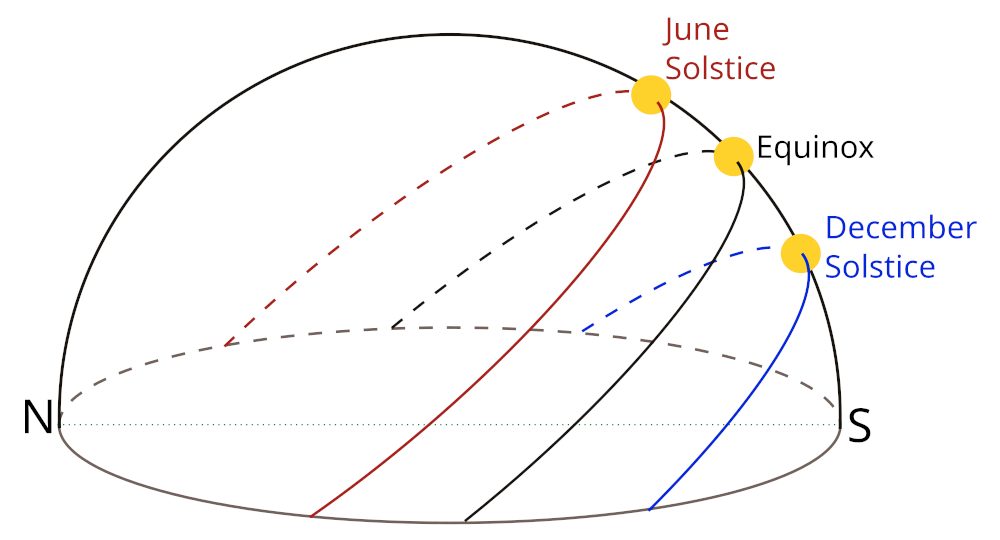
From June to December, the Sun sweeps across the sky day after day, the arc slowly descending closer and closer to the horizon. On December 21st, it stalls its descent as if pondering whether to continue until it disappears entirely never to return, or to reverse itself and rise once again. This marks the winter solstice. Thankfully, a few days later, the Sun noticeably begins to ascend, sweeping higher overhead and will continue to rise until the following June.
At some point after leaving the sanctuary of the trees 4 million years ago and steadily learning to walk upright, early humans surely noted this pattern year in and year out and looked on with concern each time the Sun took that moment to ponder its intentions. Perhaps, we probably thought, this was the year when the Sun chooses not to rise once again, sentencing us all to frigid cold, darkness, and death.
And so, humans, not understanding the dynamics of their universe, anthropomorphized the Sun or its caretakers into thinking, persuadable entities that needed to be appeased—gods and goddesses. Whether 4 million years ago (early humans) or 200 thousand years ago (modern humans) or 10 thousand years ago (man at the dawn of agriculture and civilization) we simply could not fathom how the Sun and the Earth negotiated their activities. We only recently cracked that code. But even with this new understanding, that those millions of years of fear confusion is hard to shake off. We've created tens of thousands of gods in that space of time. (Those are the ones we know of.) And even today, we cling to a number of them.
Throughout those years, we felt compelled to please these gods. To appease these gods. Helios and Tawa and Sól and Freyr and Surya and Mongke . . .. And we gave these gods and goddesses the only items of value we had to give them: food, art, time, and attention. This meant ritual and sacrifice—a sacrifice of food and sometimes . . . people. We'd kill things, harvest things, lay them out at a special place, and then stand back and exclaim, "A gift for you, oh great [ . . . ]. Please bring back the light and warmth!"
We'd sacrifice and dance, and hold our breath for a few days. And then on or around December 25th (more on that in a second), we'd detect a change and track the arc of the Sun rising once again. The sacrifice worked!
O' Ye Poor Beleaguered Postal Worker
Today, most of us laugh at these sorts of superstitions. Amusingly, I see this same logic at play when our dog barks at the USPS truck.
"A stranger is attacking the house!" he barks. "BARK BARK BARK BARK!"
The truck backs out.
"Ah ha! I have fended them off!" he says, proudly smiling back toward his humans with shining eyes as the blue and white Ford Bronco drives away.
It's the same logic. The dog doesn't understand that the postal worker would have arrived and then left even if the dog didn't bark. All evidence, to him, points to just how effective his barking really was.
Humanity has made the same faulty assumption. As ancient humans, we couldn't grasp that the Sun would rise once again with or without offerings of blood and fruit. If, one year, we neglected the rituals, the Sun's return would be seen as the gods merely granting us a pass this one time. The following year, we'd make a point of doubling the sacrifice as penance.
And there you have it: the reason for the season. We collectively stand vigil from the 21st until the 25th, like dogs safeguarding the house from the postmen, going through ritualized motions, rubbing our crystals, praying, leaving small sacrifices, or whatever, until we can finally detect the Sun once again ascending in the sky. A cause for celebration, for we shall survive for another year. Hallelujah and amen!
The Solstice and Christmas
Winter solstice: From the Latin sol (Sun) and sistere (to stand still). We also call it Midwinter even though this event technically marks the beginning of winter and not the middle. Zooming out on the calendar, though we recognized many seasons, we'd colloquially often often refer to autumn + winter (the colder season) as simply 'winter.'
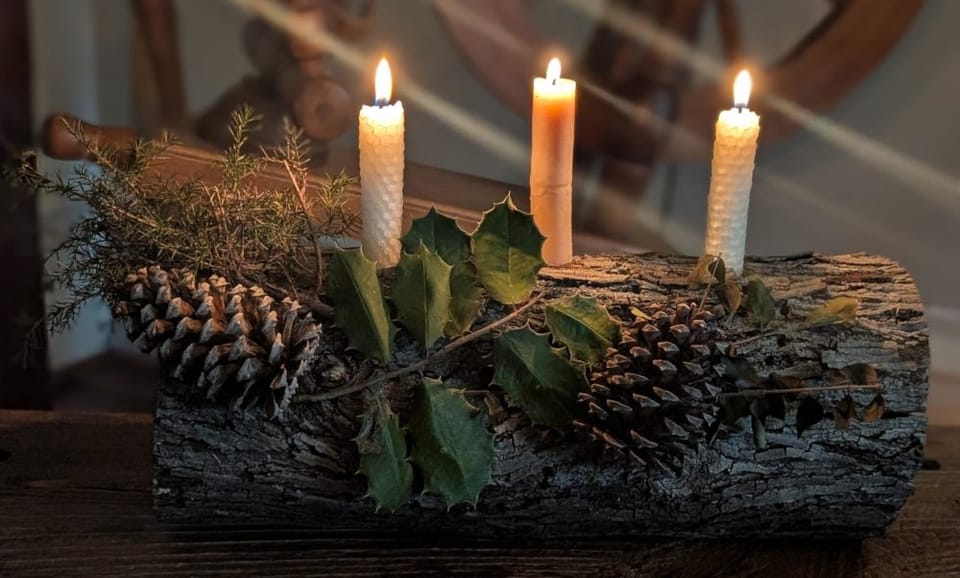
Let's talk about Christmas a bit. December 25th. All of the Christian holidays were very intentionally and strategically scheduled to land right in the midst of older rituals and celebrations. Christianity is, of course, a very new religion, and the Roman Catholic Church wanted converts. And so, in roughly year 336 CE, a new holiday was established and Christmas came to be celebrated on December 25th at the exact same time most of the planet was busily celebrating the renewal of the Sun's pattern for the next year. Other holidays were invented and reschedule in the 300s as well. New dates were set for Easter (during fertility rituals celebrating the Spring Equinox), St. John's Day (Midsummer), All Hallow's Eve or Halloween (Autumn Equinox), and more. We still maintain some echos of the past, though: Yule trees and logs (see photo above), the Ostara bunny, maypoles, etc.
Telescopes and Astrophysics
Today, we have telescopes and computers and physics, and a real understanding of how the universe works with some detail. We don't have to wait days to witness with the naked eye that small change in the Sun's pattern to know that the Sun is rising once again. We know the moment the pendulum will hit its apex down to the fraction of a second. And today, at 15:03 UTC (10:03 EST) the we know with certainty Sun will halt its descent before then beginning its slow ascent.
Still, we humans have been attempting to appease the gods since we first looked quizzically up at the sky and scratched our heads in fear and wonder. We sacrificed. We danced. And we danced some more until the Sun returned, with a promise to warm our skins, filling us with hope and joy.
Happy Midwinter!
Um. OK. Southern Hemisphere people: Just flip the days, but don't expect the Church to move Christmas to June 25th for you. What is done is done. Happy Midsummer. Now, dance!